
Earlier this year, my son and I went for an evening run to train for our upcoming HYROX. Somehow, the roads were empty, and the sun was starting to wane. Perfect conditions for a road run.
I stayed with him for the first few kilometres, but in the final two kilometres, he pulled away effortlessly. I tried to push hard and keep up. My legs felt heavy and my lungs burned, but the distance between us kept growing.
Not long ago, I used to run 10 kilometres in the morning and then play football against my son in the evening, in an adults-versus-teens six-a-side game. He was so in awe of me. He would tell all his teammates that his dad was training for a marathon.
That was when I was 45, and he was 17.
Today, I’m 58, and he’s nearing 30.
Even though my super-fit period was thirteen years ago, it feels like yesterday. After reflecting on my mortality and feeling all nostalgic about how fit and strong I used to be, I calculated how many years I’ve got to live. Let’s say I’m lucky and live another 32 years.
I was happy with that until I came across something called Janet’s Law.
In 1877, Paul Janet, a French philosopher, claimed that the perceived length of a year depends on how much of your total life you have already lived. So, as we grow older, a single year becomes a smaller fraction of our total life.
For example, at age 5, one year is 20% of our life, which is why it feels long. But at age 50, one year is only 2%, and that’s why time flies so quickly.
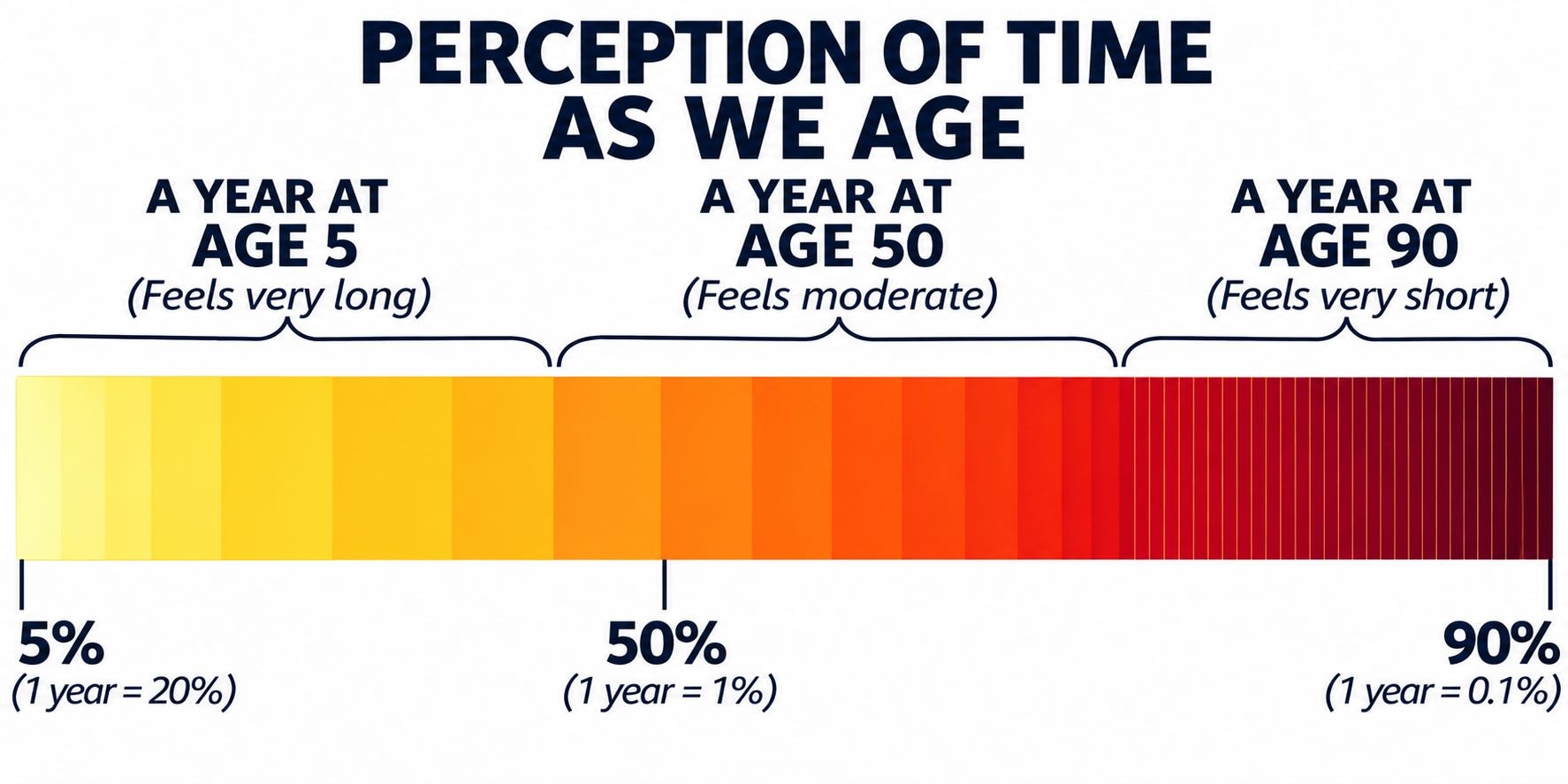
Created by AI
So, at 58, mathematically, I have lived 64.4% of a 90-year life. With 32 years left, I have 35.6% of my life to live.
But Janet’s Law on how we perceive time means I’ve already lived 91.3% of my life and have only 8.7%, or less than eight years, of my life to live.
Sobering. Sad. Depressing.
But the clock is the clock.
Seneca wrote about this almost two thousand years ago. Most of us, he wrote, realise that life “had passed away before we knew it was passing.” Time “will cause no commotion to remind you of its swiftness, but glide on quietly.”
I guess that’s how the last thirteen years have passed. Swiftly. Quietly.
I’ve lived most of my life at speed. I was trying to fill the time with a lot of things to do. Yes, time flew, but I don’t remember much of it. So I don’t need to run like a headless chicken ticking off boxes; I need to live more fully.
“Life is long,” Seneca wrote, “if you know how to use it.”
Modern psychology agrees with Seneca: that years seem longer and fuller when we are children has more to do with memory. Our childhood is full of discovery and firsts, so the brain records everything in great detail. As we age, we follow repeated patterns and encounter less novelty, so the brain compresses those years efficiently.
Psychologist and writer Claudia Hammond echoes this thought and calls it the holiday paradox. When we go somewhere new, time flies, but looking back, it feels long because it’s full of new memories. Meanwhile, routine drags and becomes nothing in hindsight.
Janet says the years get shorter because of simple maths. Of course, Janet’s Law isn’t scientifically based; it’s more a philosophical model of subjective time perception.
Psychologists say time shrinks because we stop doing new things. That is liberating, because now we have a choice in how we live.
I felt this happen when, on a whim, which is how most of my better decisions arrive, I decided to sign up for a HYROX race in Barcelona on 14 May. I’ve written about it here. But looking back now, those five days in Barcelona were long and full. The city, the buzz of the event, and the camaraderie I felt with the group remain among the best things I’ve done in a long while.
Three years after our Peru trip, I still have visions and memories of the Salkantay Trail to Machu Picchu. It was so different to my other holidays that I guess my brain had to work overtime to detail it.
The need for frantic urgency, doing things for the sake of doing them, is quieting down within me as I hold both presence and meaningful urgency.
Going for long walks, having deep conversations with good people around me, and journalling my thoughts and reflections daily, which most of the time become my blog posts, means that I slow down my days and actions.
That presence, coupled with big personal goals like finishing a new book by the end of 2027, makes me live fully. These big, meaningful goals make me come alive, feel useful and feel that I matter in this world.
I hope to make the 32 years left feel like 32 actual years.
I looked at my son, now far ahead. I stopped chasing. I smiled. I remembered.